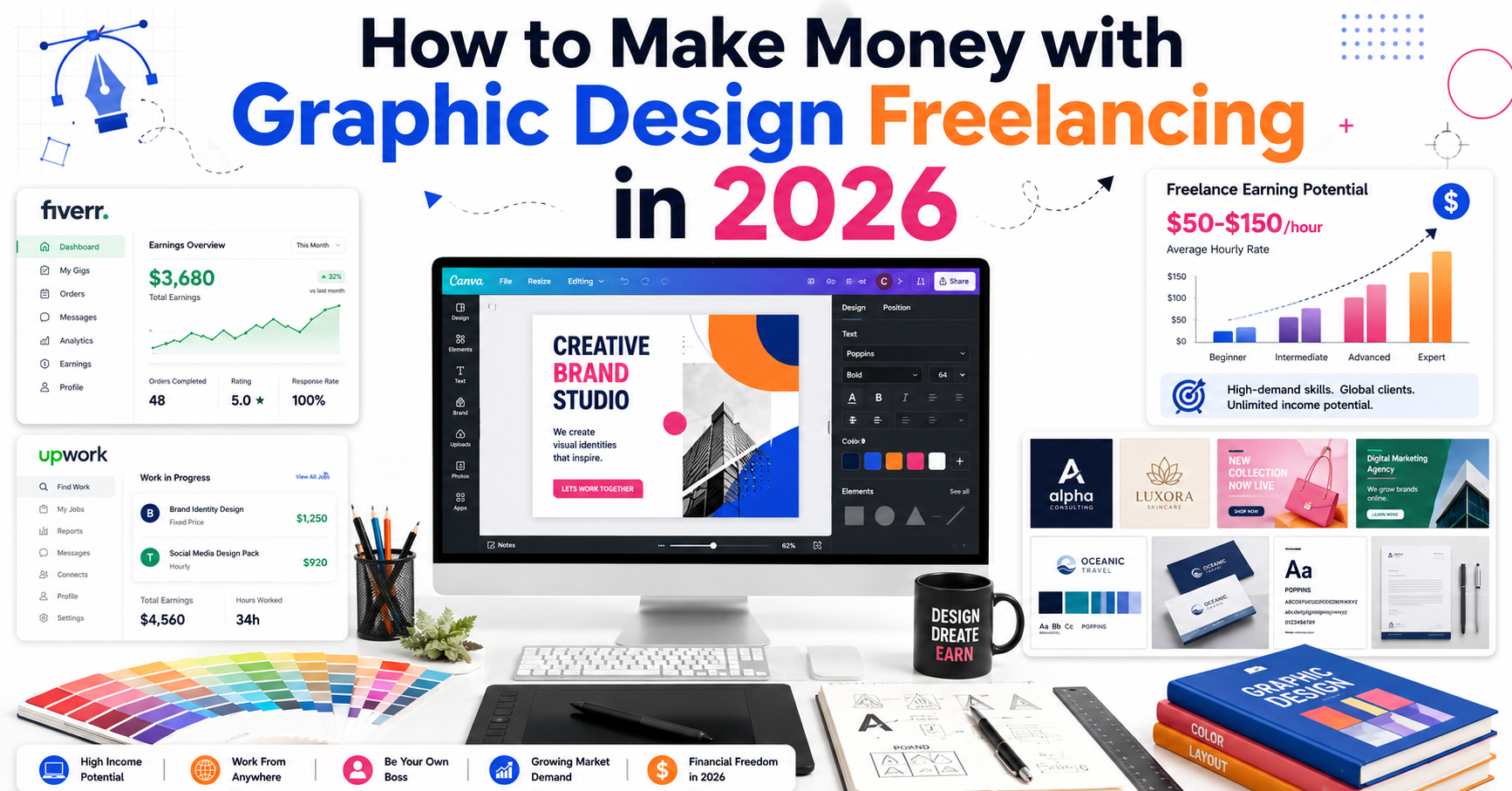
I became a graphic designer by necessity, not passion.
My small business needed a logo. I could not afford to pay a designer. So I opened Canva on a Saturday morning and spent three hours experimenting. I tried different fonts, color combinations, and layouts. By Sunday, I had something that looked professional.
My business partner saw it and asked if I could design some social media graphics for our marketing. I said yes. I spent another few hours and created a set of posts. They looked good. Actually good. Not amateur-hour good. Professional good.
A few weeks later, a friend asked if I could design a logo for her new side business. I charged her two hundred dollars. It took me five hours. Forty dollars per hour.
I realized something in that moment — graphic design is one of the most accessible freelance skills, and it pays real money.
But here is what most people miss. Graphic design is not just logos and social media posts. It is branding. Website design. Book covers. Packaging. Presentations. Print materials. The demand is enormous. The barrier to entry is low. And the income potential is genuinely high.
In 2026, there are more ways to make money as a graphic designer than ever before.
Why Graphic Design Freelancing Is One Of The Most Underrated Skills
The numbers tell the story.
Graphic designers are consistently listed as one of the most in-demand skills on Upwork and Fiverr. Thousands of projects are posted daily. Logos, website design, social media graphics, book covers, packaging, presentations. Businesses of all sizes need design work, and most cannot afford to hire a full-time designer.
The economics are simple. A small business owner spends two weeks trying to design their own logo using Canva. The result looks amateurish. They finally hire a designer for three hundred dollars. Five hours of work. Sixty dollars per hour. For a professional designer with a portfolio, the rate is easily two to three times higher.
Large companies budgets are even bigger. A website redesign might cost five thousand to fifteen thousand dollars. A rebrand package might cost ten thousand plus. The income potential scales dramatically if you build the right portfolio and client base.
Additionally, the barrier to entry is remarkably low. You do not need expensive equipment. You do not need a degree in design. You do not need years of experience. You need competence with a design tool and the ability to create work that solves client problems.
The competitive landscape is intense at the low end. Thousands of designers are offering cheap logo design services. But as you move up in quality and specialization, competition drops dramatically. A designer who specializes in e-commerce packaging design faces far less competition than a generalist. And they charge far more.
| Experience | Monthly Income |
|---|---|
| Month 1 | $0–$150 |
| Month 2–3 | $150–$500 |
| Month 4–6 | $600–$1,500 |
| Month 7–12 | $2,000–$3,000 |
| Year 2+ | $3,000–$5,000+ |
The Different Types Of Graphic Design Work
Graphic design is not monolithic. There are several distinct categories, and different types pay very differently.
Logo design is the most common entry point. Businesses need logos. They are willing to pay for good ones. Beginner designers charge one hundred to three hundred dollars per logo. Experienced designers charge five hundred to two thousand dollars. The variation depends on complexity, revisions, and the designer’s experience level.
Social media graphics includes Instagram posts, Facebook graphics, LinkedIn graphics, TikTok thumbnails, and other platform-specific content. These are smaller projects but often recurring. A designer might charge two hundred to five hundred dollars per month to manage a client’s social media design needs.
Website design and UI design involves creating the visual interface for websites and applications. This is more technical than pure graphic design but the pay is significantly higher. Website design projects might range from one thousand to ten thousand dollars depending on scope.
Branding packages involve creating a cohesive brand identity — logo, color palette, typography, brand guidelines, and sometimes business cards, letterhead, and other collateral. Full branding packages typically range from two thousand to ten thousand dollars or more.
Book cover design is a specialized niche. Authors need book covers. Many are willing to pay one thousand to three thousand dollars for professional design. The work is focused and profitable.
Packaging design involves designing product packaging. This is higher-value work and typically ranges from one thousand to five thousand dollars per project.
Print design includes business cards, flyers, brochures, posters, and other print materials. These are usually smaller projects but high volume. Many designers batch similar work together.
For someone just starting out, I would recommend focusing on logo design or social media graphics. These have the most demand, most accessible entry point, and fastest path to client work.

Step 1: Learn A Design Tool
You cannot freelance as a designer without being able to design.
Canva is the beginner-friendly option. It is free. It has templates for everything. It has massive libraries of images, icons, and fonts. You can create professional-looking work in Canva without any design training. Seriously. Canva is incredibly powerful.
Adobe Creative Suite is the professional standard. Photoshop for image editing and layout. Illustrator for vector graphics and logos. InDesign for print design. These tools are expensive and have a learning curve. But they are the industry standard and clients expect them.
I recommend starting with Canva. Spend a month creating design practice pieces using Canva. Build your portfolio. Once you are confident and have clients, invest in Adobe if you want to specialize in higher-end work. But honestly, many successful designers use Canva their entire careers.
The way to learn is to do. Download Canva. Create fifty practice designs. Logos, social media posts, book covers, whatever. Try different styles. Fail repeatedly. After fifty designs, you will have a solid understanding of the tool and design fundamentals.
Beyond tool training, study design principles. Color theory. Typography. Composition. Balance. Hierarchy. These are the foundations of good design. You can learn these from free YouTube videos and blogs. Understanding them makes you dramatically better.
Step 2: Develop A Design Style And Niche
This is where most beginners fail. They try to be everything.
You need a point of view. A style. A niche.
Are you into minimalist design? Bold and colorful? Vintage? Modern? Pick a direction. Create ten to twenty logo designs in that style. Create social media graphics in that style. Create mock book covers in that style. Develop consistency.
Additionally, pick a niche. Do you want to design for tech startups? Coaches and consultants? E-commerce brands? Nonprofits? Picking a niche is not limiting. It is strategic. When you specialize, you charge more, win more, and face less competition.

A designer who says “I do logo design” faces thousands of competitors. A designer who says “I design logos for tech startups and SaaS companies” faces far fewer competitors and can charge significantly more.
Your niche should be either something you already know about or something you are genuinely interested in learning about.
Step 3: Build A Portfolio
You cannot charge real money without proof that you can design.
Create fifteen to twenty of your best design pieces. These can be practice designs. They can be redesigns of real brands. They can be designs for friends or family done for free or cheap. The goal is to have clear examples of your work that demonstrate your style and skill.
Put these in a simple portfolio website or PDF. The portfolio does not need to be fancy. It just needs to clearly showcase your work.
Alternatively, offer to design for a few small businesses for free or cheap. The goal is to get real client work in your portfolio. Once you have three to five real client projects, you have proof that you can work with clients and deliver.
Step 4: Set Up On Freelance Platforms
The easiest way to land your first clients is through Upwork and Fiverr.
On Upwork, create a detailed profile. Show your portfolio. Explain your design style and niche. Set your rate. Upwork takes commission, but it provides access to thousands of clients.
On Fiverr, create gigs for your services. “I will design a professional logo for your business.” Set your price and package tiers. Fiverr is good for smaller, faster projects.
Both platforms are worth using. Upwork is better for higher-paying longer-term projects. Fiverr is better for quick, smaller gigs.
Step 5: Land Your First Clients
Apply to every design job that matches your skill level and niche.
Customize your proposals. Show that you understand what the client needs. Reference their business or previous work specifically. If they want a logo for a fitness app, mention that you have experience designing in that space.
Bid competitively but not desperately. If experienced designers are bidding five hundred dollars and you bid one hundred, you will get hired but attract clients who do not value quality. Bid a fair rate for your experience level.
Expect your first projects to take longer than they should. You will be slower as you refine your process. But do excellent work. Get testimonials. Use these to land your next client at higher rates.
Beyond platforms, reach out directly to potential clients. Find businesses that look like they need design work. Email them. Offer to create a sample design to show what you can do.
Step 6: Scale Your Rates And Workload
Once you have your first client, your job is to deliver great work and build from there.
Start at reasonable rates. One hundred to two hundred dollars for a logo is fair for a beginner. As you build a portfolio and testimonials, increase your rates. Three hundred to five hundred dollars for a logo is standard for experienced designers. Premium designers charge eight hundred to two thousand dollars or more.
The scalability comes from building recurring clients, raising rates, and doing more complex, higher-paying work.
How Much You Can Actually Earn
In month one, you make zero dollars. You are learning and building your portfolio.
In months two to three, you land your first client. Maybe a logo design for one hundred fifty dollars. That is one hundred fifty dollars in one month.
In months four to six, you have a few clients and are getting more offers. You might design two to three logos per month at two hundred dollars each. Plus some social media graphics. That is six hundred to one thousand dollars per month.
By months seven to twelve, you have built a reputation and have repeat clients. You might be designing one logo per week at three to four hundred dollars each. Plus monthly social media management at two to three hundred dollars. That is two thousand to three thousand dollars per month.
By year two, if you have specialized in a lucrative niche like e-commerce or SaaS branding, you might be earning three thousand to five thousand dollars per month or more.
The people earning fifty to one hundred fifty dollars per hour are typically those who have built strong client relationships, specialized in higher-paying niches, or moved into higher-value work like website design or full branding packages.
Common Mistakes Graphic Designers Make
Most new designers make predictable mistakes.
Not specializing. You design everything. You charge the same for all projects. You face maximum competition. Specialize in a niche and charge more.
Underpricing. You think you have to charge cheap to compete. You do not. Charge a fair rate for your work. Low rates attract clients who do not value quality.
Not asking for client feedback. You design something beautiful in your opinion but it does not solve the client’s problem. Always ask clarifying questions before starting. Understand what they need.
Not getting testimonials. After a successful project, ask the client for a testimonial or case study. These are gold for attracting future clients.

Over-designing. You make things too complex. Too many elements. Too many colors. Less is more. Clean, simple, focused design usually wins.
Not tracking your time. You work for ten hours and charge two hundred dollars. That is twenty dollars per hour. Start tracking time so you know your actual hourly rate.
Final Thoughts
Graphic design freelancing is one of the most accessible, scalable ways to make real income online in 2026.
Demand is enormous. Businesses constantly need design work. Supply is limited compared to demand. Clients are willing to pay real money for quality design.
Start by learning a tool. Build your portfolio. Set up on freelance platforms. Land your first clients. Deliver excellent work. Build from there.
Within six months, you can have consistent monthly income from design work. Within a year, you can be earning two thousand to three thousand dollars monthly or more. Within two years, with specialization and premium positioning, you can be earning five thousand plus monthly.
Frequently Asked Questions
Do I need a design degree to freelance as a graphic designer?
No. Many successful freelance designers are self-taught. What matters is skill and portfolio, not credentials.
How long does it take to create a logo?
For experienced designers, two to four hours. For beginners, four to eight hours. As you develop a process, you get faster.
What is a realistic rate for a beginner designer?
One hundred to three hundred dollars per logo is fair for a beginner. As you gain experience and testimonials, charge three hundred to eight hundred dollars. Premium designers charge one thousand plus.
Should I use Canva or Adobe?
Start with Canva. It is free, fast, and powerful. Move to Adobe if you want to specialize in professional print or web design. But many designers use Canva their entire careers.
How do I find my niche?
Pick something you already know about or are genuinely interested in. Then create ten designs in that niche and specialize in marketing to that audience.
Can I do this part-time while working another job?
Absolutely. Graphic design is flexible. You can work evenings and weekends. Start part-time and scale as demand increases.
What if I am not naturally talented at design?
Design is a learnable skill. Study existing good design. Practice constantly. You will develop the skill through repetition and feedback.
Leave a Reply