I discovered something unexpected a few years ago when I needed a wedding planning template for a friend’s wedding.
I went to Etsy looking for something simple — a timeline, a budget tracker, a guest list organizer. Something that would help us stay organized for the big day. What I found was not just a few options. There were hundreds. Thousands, actually. People were selling wedding planning templates for fifteen dollars, twenty dollars, thirty dollars each. And they were not even particularly fancy templates. Many were just well-organized spreadsheets or PDF documents designed to solve one specific problem.
The fact that struck me was this — someone had created a wedding budget template once, listed it on Etsy, and was probably still making sales from it years later. No inventory. No shipping. No customer service issues. No returns. Just people buying a digital file and downloading it immediately.
That moment planted a seed. What if you could build real income by creating digital products that solve specific problems for specific audiences? What if you did not need to manage physical inventory or deal with logistics at all?
In 2026, that is exactly what thousands of people are doing on Etsy. And the opportunity is bigger than ever.
The Digital Products Boom on Etsy in 2026
The numbers tell the story. Etsy digital downloads grew thirty-five percent year-over-year. That is not a small increase. That is explosive growth. And unlike physical products, digital products have zero marginal cost — you create it once, and you can sell it infinitely.
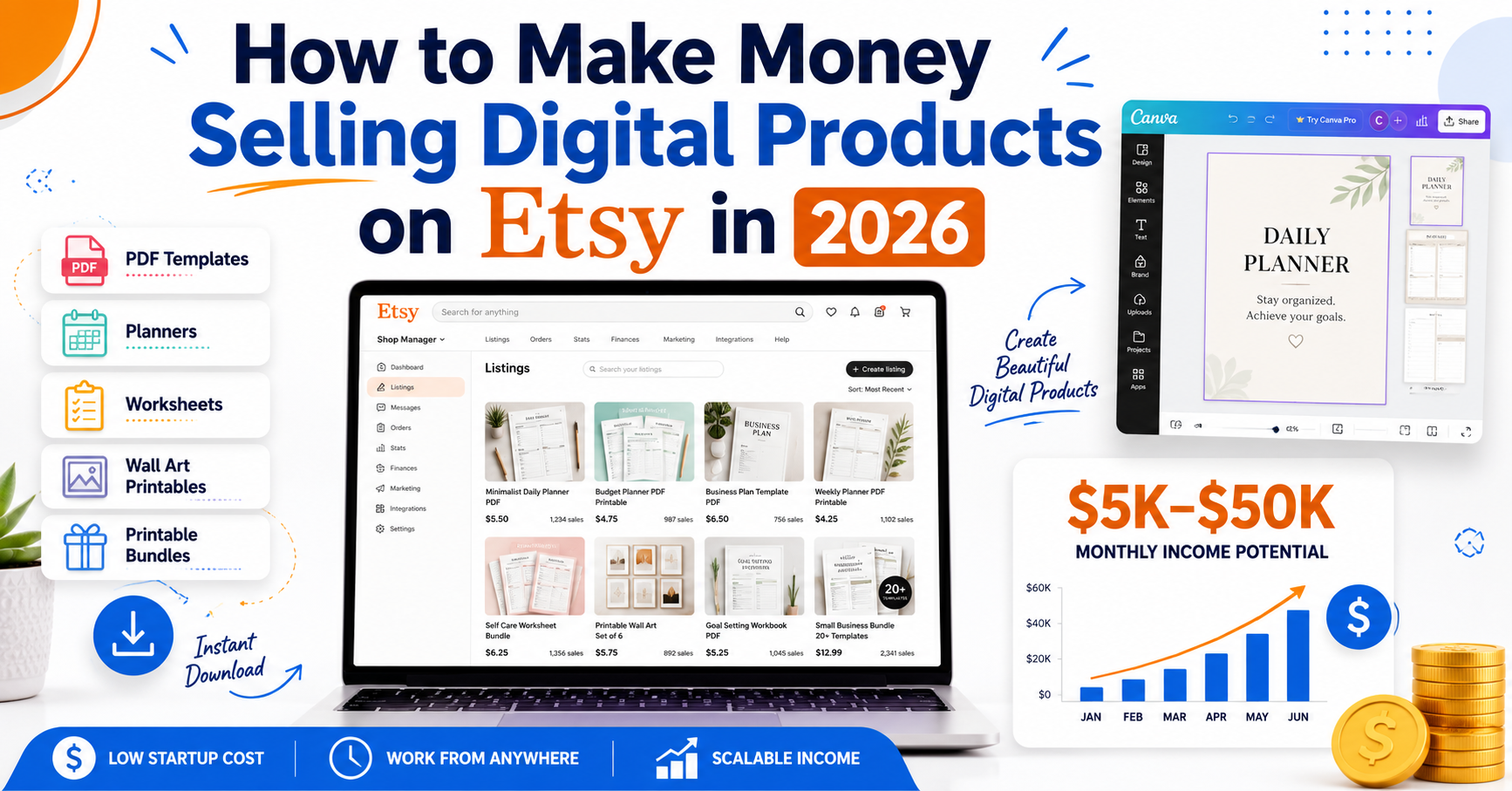
Top sellers on Etsy selling digital products are making five thousand to fifty thousand dollars per month. Some are making more. These are not celebrities or people with massive followings. These are regular people who identified a problem, created a solution, and packaged it as a downloadable product.
The reason this works is simple. Millions of people use Etsy every single month actively shopping. They come to Etsy with purchasing intent. They are already in a buying mindset. If you have a product that solves their specific problem, they will buy it.
Additionally, the barrier to entry is incredibly low. You do not need technical skills. You do not need design experience. You do not need a warehouse or shipping logistics. You need one thing — the ability to create something useful in a format that can be downloaded.
In 2026, the demand for digital products is particularly strong in certain categories. Wedding and event planning templates. Small business templates. Productivity and organization systems. Social media content calendars. Budget and finance trackers. Notion dashboards. Printable planners. The list goes on.
What makes this different from other online businesses is the scalability with zero additional work. Write a blog post and you have to maintain it. Run a service business and you have to deliver the service every single time. Create a digital product and sell it a thousand times without doing any additional work.
Understanding the Types of Digital Products That Sell
Not all digital products perform equally on Etsy. Understanding what actually sells helps you choose the right product to create.
Templates are the largest category. These are files that people can download and customize for their own needs. Wedding planning templates. Budget spreadsheets. Social media content calendars. Project management templates. The appeal is that someone else has done the hard thinking — the structure, the format, the organization — and now the buyer just has to fill it in with their own information.
Printables are closely related but specifically designed to be printed out. Planner pages. Meal planning sheets. Fitness trackers. Chore charts. Goal-setting worksheets. People download them and print them at home. The market for printables is enormous because the use cases are endless.
Notion templates have exploded in 2026. Notion is a productivity tool that millions of people use. Pre-built Notion workspaces that solve specific problems — task management systems, CRM systems, budget trackers — sell for fifteen to seventy-nine dollars. People buy them because they save hours of setup time.
Ebooks are another category. These are longer-form written content usually as PDF files. Guides, tutorials, workbooks. An ebook on how to plan a wedding. A guide to starting a freelancing business. A workbook for managing anxiety. These typically sell for five to twenty dollars and have relatively high profit margins.
Checklists and worksheets are simpler products but still valuable. A checklist for moving to a new city. A worksheet for tracking spending. A packing list for vacation. These sell well because they are inexpensive and solve a very specific problem.
For a beginner, I would recommend starting with templates, printables, or checklists. Why? Because they are relatively easy to create using tools like Canva or Google Sheets. You do not need design or programming skills. And the market demand is clear and proven.
| Stage | Monthly Income |
|---|---|
| Month 1 | $0-$50 |
| Month 2-3 | $100-$500 |
| Month 4-6 | $500-$2,000 |
| Month 7-12 | $1,000-$5,000+ |
| Advanced Sellers | $5,000-$50,000+ |
Step 1: Identify Your Niche and Validate Demand
Before you create a product, you need to know that people actually want it.
Start by identifying a problem that people actively have and actively search for solutions to. Do not start with what you personally want to create. Start with what people actively want to buy.
Use tools like Google Trends to check search volume. Search for keywords like “wedding planning template,” “budget template,” “meal planner printable,” “social media content calendar.” If people are searching for it, that is a strong signal that demand exists.
Go to Etsy and search the same keywords. Look at what already exists. Are there products with good reviews and lots of sales? If yes, that is even stronger validation that demand exists. If there are no results, demand might not exist. If there are some results with good reviews, that is the sweet spot — demand is proven and you have room to compete with a better product.
Read the reviews on existing products. What are people saying? What problems are they solving? What complaints do they have about existing products? This tells you exactly what you should focus on in your own product.
Check the price points of existing products in your niche. If everything is priced at ninety-nine cents, the market might not support a higher price. If products are selling for twenty-five dollars with good reviews, you know the market will support that price.
Finally, ask yourself — can I reach the audience that wants this product? Can I drive traffic to my listing through SEO, social media, or email? The best product in the world does not sell if no one can find it.
Step 2: Create Your Digital Product
Once you have validated demand, you create the actual product.
For templates and printables, Canva is the easiest tool. Canva has pre-built templates that you can customize. You do not need design experience. You can create professional-looking printables and templates in Canva in a few hours.
Alternatively, Google Sheets or Excel work great for templates. A budget template can just be a well-organized spreadsheet with formulas built in. A content calendar can be a spreadsheet. These are incredibly useful and people buy them.
For Notion templates, you build a workspace within Notion, test it, then export it as a template that people can duplicate into their own Notion workspace.
For ebooks and guides, you write the content in Google Docs or Word, then export as a PDF. Simple as that.
The key to creating products that sell is solving a specific problem extremely well. Do not create a vague general product. Create something very specific. Not a “wedding planning template” but a “wedding planning timeline and budget tracker for outdoor weddings under five thousand dollars.”
The more specific, the better. Specific products attract passionate buyers who are willing to pay because the product speaks directly to their exact situation.
Quality matters. Spend time on your product. Make sure it is useful. Make sure it is well-organized. Make sure it actually solves the problem it claims to solve. Your first product is your sales page for your next products. If you rush it, you will not get reviews. Without reviews, you will not get sales.

Step 3: Set Up Your Etsy Shop
Creating an Etsy shop takes about thirty minutes and costs almost nothing.
Go to Etsy.com. Click “Sell on Etsy.” Create your shop. Choose a shop name — ideally something related to your niche or product category. Create a shop icon and banner. Write a shop description that explains who you are and what you sell.
Here is the important part — Etsy charges a listing fee per product. In 2026, this is typically a few cents per listing. When someone buys, Etsy also takes a commission and payment processing fees. These fees reduce your profit, but the fees are reasonable given that Etsy handles all the hosting, traffic, and payment processing for you.
Your shop is now live and visible to millions of monthly Etsy shoppers. That is the power of Etsy — you do not have to drive all your own traffic. You just have to create a good product and optimize your listing so people can find it.
Step 4: Optimize Your Listings for Discoverability
Creating a great product means nothing if nobody can find it.
Etsy search works similarly to Google. People search for keywords, and Etsy shows relevant products. The more optimized your listing is for the keywords people search for, the more traffic you get.
Include your target keyword in your product title. “Wedding Budget Planner Template” is better than “Template One.” “Social Media Content Calendar Printable 2026” is better than “Calendar Template.”
Write a detailed product description that explains exactly what the buyer is getting, who it is for, and how to use it. Include relevant keywords naturally throughout the description.
Use all available tags — Etsy allows up to thirteen tags. Use keywords people actually search for. If your product is a wedding planning template, tags might include “wedding planner,” “wedding budget,” “wedding timeline,” “printable wedding planner,” and so on.
Include a preview image that shows what the product actually looks like. People want to see exactly what they are buying before they purchase. A clear preview image dramatically increases conversion rates.
Price competitively. Look at what similar products are priced at. Price in that ballpark. Many digital product sellers use a tiered pricing strategy — different pricing for different versions of the same product.
Step 5: Drive Traffic and Build Your Business
Etsy traffic helps, but you can accelerate growth by driving additional traffic.
Pinterest is incredibly powerful for Etsy sellers. Create pins for your products and link them to your Etsy listings. People on Pinterest are actively looking for solutions and ideas. Wedding planning pins drive traffic to wedding planning templates. Budget tracker pins drive traffic to budget templates.
Instagram and TikTok work by showing your products in action. A wedding planner using your wedding planning template. Someone using your social media content calendar. Short, authentic videos showing the value of your product drive curiosity and sales.
Email marketing to people who have shown interest in your products. If someone buys one template, they are likely to buy another. Build an email list and promote your new products to people who have already bought from you.
Your own blog or website becomes valuable once you have multiple products. A blog post about “Ten wedding planning templates for outdoor weddings” that links to your Etsy products drives both traffic and sales.
What You Can Realistically Earn
Let me be honest about the income potential.
In month one, you create a product and list it. You might make zero sales or a few sales if you are lucky. Expect zero to fifty dollars.
In month two to three, with a few products listed and some initial marketing, expect one hundred to five hundred dollars per month if you are actively driving traffic.
By month four to six, with multiple products, some reviews, and consistent traffic generation, expect five hundred to two thousand dollars per month.
By month seven to twelve, if you have found successful products and are actively marketing, expect one thousand to five thousand dollars per month.
The people earning five thousand to fifty thousand dollars per month are typically those who have been doing this for a year or more, have built a catalog of twenty-plus products, have refined their marketing, and have products with strong reviews and good search visibility.
The income potential is real. But it requires creating quality products, marketing them consistently, and refining based on what sells.

Common Mistakes Beginners Make
Most new digital product sellers make predictable mistakes.
Creating products nobody wants. This is solved by the validation step. Do your research before you create.
Creating products that do not solve a clear problem. Vague, general products do not sell well. Specific products that solve specific problems sell.
Poor product quality. A template that is disorganized or confusing will not get positive reviews. Spend time making your product actually useful.
Weak listing optimization. You create a great product but use vague keywords in your title and description. People cannot find it. Learn basic Etsy SEO.
Not marketing at all. You list a product and hope it sells organically. Etsy drives some traffic, but active marketing through Pinterest, Instagram, and email dramatically increases sales.
Giving up too quickly. You create one product, it does not sell immediately, and you move on. Successful sellers often have multiple products and test different approaches.
Final Thoughts
Selling digital products on Etsy is one of the most accessible, scalable online businesses in 2026.
The barrier to entry is nearly zero. You do not need capital. You do not need special skills. You just need to identify a problem people have, create a solution, and package it as a downloadable product.
The income potential is real. Hundreds of thousands of people are building meaningful income streams selling digital products on Etsy. Some are doing it part-time. Some are doing it full-time. Some are earning five figures per month.
The key is starting with validation, creating quality products, optimizing your listings, and marketing consistently. Do those things and you have a real business.
Start today. Identify a problem people have. Create a solution. List it on Etsy. Then create another one. And another one. Over time, your catalog becomes an asset that generates consistent income.
Frequently Asked Questions
Do I need design experience to create digital products?
No. Tools like Canva make it possible to create professional-looking products without design skills. Google Sheets and Word work great for templates too.
How much does it cost to sell on Etsy?
Etsy charges a small listing fee per product and takes a commission on sales. The total cost is typically fifteen to twenty percent of your sale price, which is reasonable given the traffic and platform.
How long does it take to make money?
Some sellers make their first sale within days. Most take a few weeks to a few months. The timeline depends on product quality, how well you optimize your listings, and how much you market.
Can I sell the same product on multiple platforms?
Yes. You can sell the same digital product on Etsy, Gumroad, your own website, and other platforms simultaneously. Each platform reaches different audiences.
What if my product does not sell?
Try a different product. Refine your approach. Check if there is actual demand for what you created. The beauty of digital products is that the failure cost is just your time — you are not stuck with unsold inventory.
Can I create products in any niche?
Generally yes, but focus on niches with clear demand and willing buyers. Business, productivity, weddings, and fitness templates sell consistently.
Do I need an email list to sell digital products?
No, but an email list helps. You can start by relying on Etsy traffic and organic discovery, then build an email list of customers to promote future products.

Related Guides
How to Start Selling Digital Products as a Beginner in 2026
How to Sell Digital Products Online in 2026 and Make Money While You Sleep

Leave a Reply