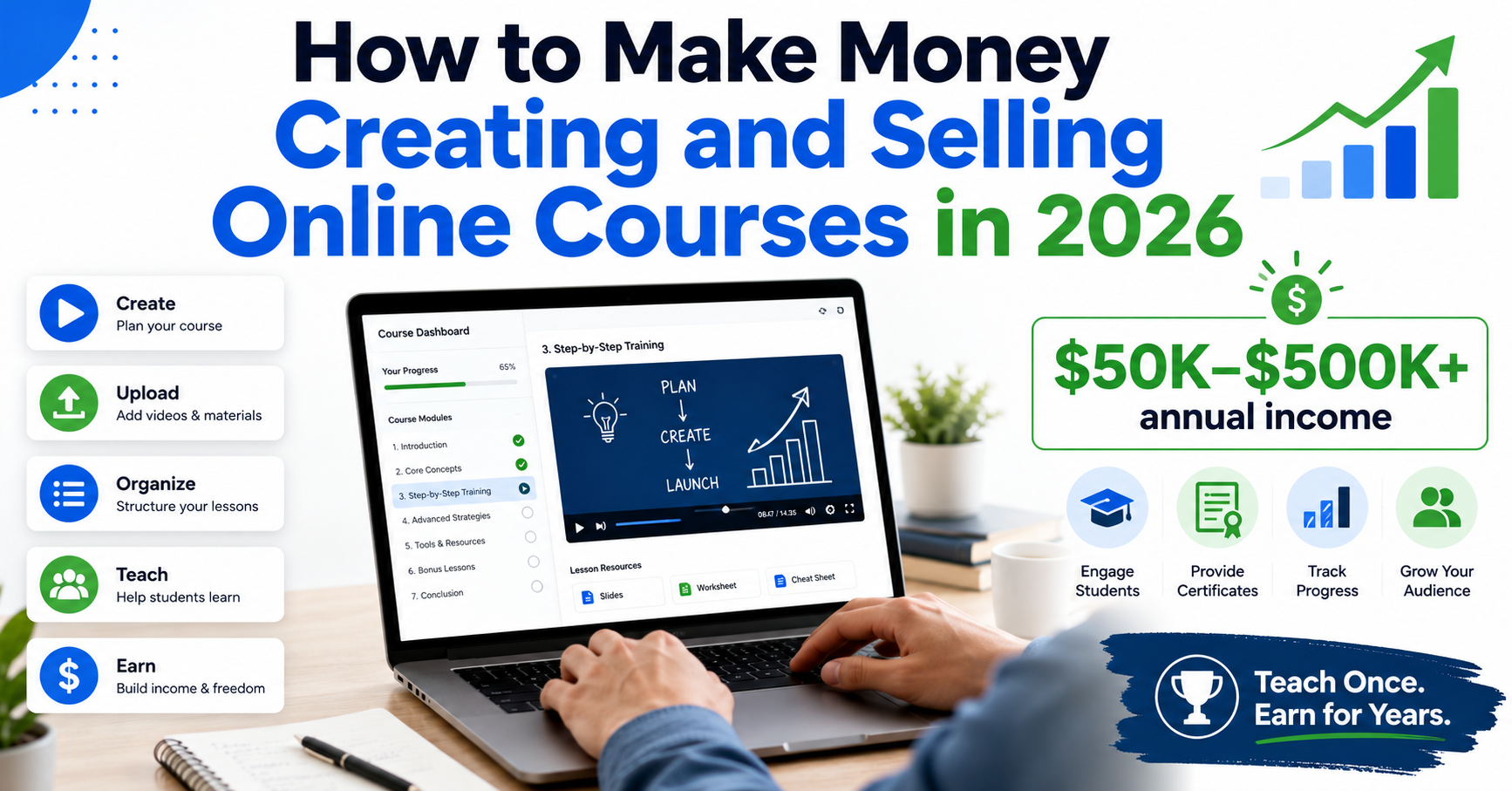
I want to tell you about one of the most legitimate ways to build serious income that I have seen in 2026.
Creating and selling online courses.
And before you think this is some saturated market or impossible to break into, let me give you the numbers. The top course creators are making between fifty thousand and five hundred thousand dollars per year. Some are making more. These are not celebrities or people with massive followings. These are regular people who took their knowledge, packaged it into a course, and sold it to people who wanted to learn.
The beautiful part is that you do not need to be an expert. You do not need a huge audience. You do not need a fancy production setup. You just need knowledge about something that people want to learn, the ability to teach it clearly, and a platform to sell it on.
I am going to walk you through exactly how this works. From choosing what to teach, to actually building the course, to getting your first students, to scaling to five figures per month. Everything.
Why Online Courses Are Such a Powerful Business in 2026
The online course market has matured significantly by 2026. This is actually good news for you because it means the infrastructure is solid and the audience is there. People are comfortable buying courses. They understand the value.
Here is what is happening right now. Businesses are spending more money on employee training and development than ever. Individuals are spending more money on personal development and skill-building. Parents want their kids to have supplementary education. People want to learn new skills to advance their careers or start side businesses.
The demand is enormous. And because courses are digital, the margins are incredible. Once you create the course, you can sell it infinitely. No inventory costs. No shipping costs. No per-unit production costs. Just pure profit after the platform takes its cut.
A course that takes you one hundred hours to create and sells for ninety-seven dollars can generate one hundred thousand dollars in revenue if one thousand people buy it. That is one thousand dollars per hour of your time. And then after the first month, you have students buying every single month without you doing anything additional.
That is the power of a course business.
The Three Types of Online Courses That Sell
Not all courses are created equal. Some types sell much better than others in 2026.
The first type is skill-based courses. These teach people a specific, measurable skill they can use immediately. How to start a freelancing business. How to code. How to write better. How to do video editing. These courses work because people buy them to solve a specific problem or advance their career. The course has clear outcomes. After completing it, students can do something they could not do before.
The second type is certification or credential courses. These lead to a recognized qualification. Professional certifications. Language proficiency certificates. Health coaching certifications. These courses work because they have external value. Completing them opens doors professionally.
The third type is hobby or interest courses. These teach people something fun or interesting. Photography for beginners. Creative writing. Meditation. Art skills. These courses work because people buy them for personal enrichment and enjoyment.
For a beginner course creator, the most reliable path is skill-based courses. Why? Because the ROI is clear. Students buy them because they want to gain a specific skill that will make them money or improve their work. They are motivated. They complete the course. They are satisfied. They leave good reviews. They refer friends.
Hobby courses can work too, but you need more marketing skill to sell them because the motivation is less immediate.

Step 1: Choose Your Course Topic
This decision matters more than anything else. The wrong topic means you will build a course that nobody wants. The right topic means you have built-in demand.
Here is how to choose correctly.
First, identify what you actually know. What skills do you have? What experience do you have? What have people asked you for help with repeatedly? Your own knowledge and experience is your unfair advantage. You can speak about it authentically. You are not trying to teach something you just learned yourself.
Second, identify what people actually want to learn. Use Google Trends. Search for your topic. Look at search volume. Is it growing? Is it stable? Look at Amazon book reviews in your category. What are people saying they want to learn? Look at Reddit communities. What questions are people asking repeatedly?
Third, identify the intersection. What do you know deeply that people actually want to learn?
For example. You might know how to do social media marketing because you have done it for five years. You might notice that small business owners repeatedly ask how to grow their social media. You create a course on social media marketing for small businesses. That is the intersection of your knowledge and market demand.
The best course topics have clear outcomes. “Learn social media marketing” is vague. “Build a profitable Instagram strategy in thirty days” is clear. Students know exactly what they will get.
The best course topics solve real problems. “Advanced Python Programming” is less compelling than “Build a web scraping tool to automate your business research in one week.”
Step 2: Validate Your Course Idea Before You Build It
Before you spend weeks building a course, validate that people actually want it.
Create a simple landing page describing your course. Use tools like Unbounce or Leadpages. Write a compelling headline. Explain what students will learn. Include a call to action — join the waitlist or pre-order.
Drive traffic to this page. Use Facebook ads. Use Google ads. Spend fifty to one hundred dollars. Track how many people click through. Track how many people actually sign up for the waitlist or pre-order.
If twenty percent or more of visitors sign up, you have a winner. That means genuine interest. If less than five percent sign up, reconsider your course idea or your messaging.
Talk directly to people in your target market. LinkedIn message them. Email them. Ask if they would be interested in learning this skill. How much would they pay for it? What specific outcomes do they want?
This validation phase should take one to two weeks. It is the cheapest insurance you can buy against spending months building something nobody wants.

Step 3: Build Your Course
Once you have validated demand, you build the actual course.
Most courses are delivered as a series of video lessons organized into modules. Module one covers the basics. Module two covers intermediate concepts. Module three covers advanced application.
Each lesson is typically five to twenty minutes long. Long enough to cover a meaningful chunk of material. Short enough that people can watch it in one sitting.
You do not need expensive equipment. A decent microphone, a screen recording tool like OBS or ScreenFlow, and basic editing software like CapCut is sufficient. Many successful courses are just screen recordings with voiceovers. No fancy production needed.
The course structure matters. Start each module with a clear learning objective. Here is what you will learn and why it matters. Then deliver the content. Then end with a summary and action step. This structure helps students retain information and stay motivated.
Most courses take three to six months to build if you are working on it part time. You can accelerate this by batching your work. Record all your lessons in one week. Edit them all in the next week. Build the course site in the third week.
Once the course is built, you test it. You enroll a few people. You get feedback. You refine the content. You improve the video quality or the explanations based on feedback.
Step 4: Set Up Your Sales Platform
You have options for where to host and sell your course.
Teachable is one of the most popular platforms. It is easy to use. It handles payments. It delivers your course content. It has built-in email marketing tools. Monthly cost is around forty to one hundred dollars depending on features.
Kajabi is more advanced and more expensive but has more built-in marketing features.
Thinkific is similar to Teachable but slightly cheaper.
Mighty Networks combines course hosting with community features so students can interact.
Udemy is a marketplace where you can list your course. You do not need your own platform, but Udemy takes a significant cut and you have less control over pricing and marketing.
For most beginners, Teachable is the best choice. It is affordable, reliable, and has everything you need to get started.
When setting up your course platform, you need to decide on pricing. Look at similar courses. What are they charging? For most skill-based courses, pricing ranges from twenty-seven dollars to two hundred ninety-seven dollars. Premium courses targeted at professionals charge higher.
A good strategy is to start at a lower price to acquire your first students and build reviews. One hundred dollars for a skill-based course is reasonable. Once you have testimonials and reviews, you can raise the price.

Step 5: Market Your Course and Get Your First Students
Building a great course is only half the battle. You need to get people to buy it.
Email marketing is the most important channel. Build an email list before you even launch your course. Create free content related to your course topic. A free guide. Free email series. Free video. Offer it in exchange for email addresses. By launch day, you have an audience to sell to.
Content marketing is powerful. Create blog posts and videos about the topic your course covers. Teach valuable information for free. At the end of each piece of content, mention your course. People who consume your free content and find it valuable will buy your paid course.
Social media works. Share your knowledge on LinkedIn, Twitter, TikTok. Build a following in your niche. Your course becomes a natural next step for people who already know and trust you.
Paid advertising accelerates growth. Facebook ads and Google ads can bring buyers directly to your course sales page. Track your spending carefully. If you spend one hundred dollars and make five hundred dollars in revenue, scale up. If you spend one hundred dollars and make fifty dollars, pause the ads.
Partnerships and affiliate marketing work. Reach out to other course creators or content creators in related niches. Offer them a commission for every student they refer. They promote your course to their audience. You pay commission only on actual sales.
For your first course, expect to make your first sales through email and content marketing. These are free channels that build over time. Your first month might bring five to ten sales. By month three, if you are consistently creating content and building your email list, you might have fifty to one hundred monthly sales.
What You Can Realistically Earn
Let me give you honest numbers based on actual course creator earnings in 2026.
In your first month after launch, expect zero to five sales. You are building momentum. People are discovering your course.
By month two to three, expect ten to thirty sales per month. Your email list is growing. Your content is getting indexed in Google. Word of mouth is happening.
By month four to six, expect thirty to one hundred sales per month. This depends heavily on your marketing effort and how good your course actually is. A course that gets great reviews converts better.
At one hundred monthly sales at one hundred dollars per course, that is ten thousand dollars per month. Take away platform fees and advertising costs, and you are looking at eight thousand to nine thousand dollars monthly profit.
Many successful course creators have multiple courses. First course generates five thousand per month. Second course generates three thousand per month. Third course generates two thousand per month. Suddenly you are making ten thousand dollars per month with relatively passive income.
The people making fifty thousand to five hundred thousand dollars per year are typically running multiple courses, have built significant email lists and audiences, and have invested in paid advertising.
Common Mistakes That Kill Course Sales
Most first-time course creators make predictable mistakes.
Building a course nobody wants. This is solved by the validation step. Do not skip it.
Poor course quality. Rambling lectures. Unclear explanations. No structure. Students give bad reviews. Bad reviews kill sales. Invest time in making your course actually good.
Weak sales page. Your sales page is the most important marketing asset you have. It needs a compelling headline. Clear benefits. Testimonials. A clear call to action. Spend time on this.

No email list. You are entirely dependent on paid ads and organic discovery. Build an email list before you launch. This is your most valuable asset.
Overpricing early. Charge too much for your first course and you get no sales. Charge less. Build reviews. Raise prices on future courses.
Giving up too early. Month one and two are slow. Month three picks up. By month four to six you have real momentum. If you quit after month one, you never see the real results.
Frequently Asked Questions
Can beginners make money selling online courses in 2026?
Yes, beginners can make money selling online courses, but success depends on choosing the right topic, validating demand, creating useful lessons, and consistently marketing the course.
Do I need a big audience to sell an online course?
No, but having an email list, blog traffic, YouTube channel, or social media audience makes sales easier.
What is the best platform to sell online courses?
Beginners can start with platforms like Teachable, Thinkific, or Udemy. Advanced creators may prefer Kajabi or similar all-in-one tools.
How much should I charge for my first course?
Many beginner courses start between twenty-seven and one hundred ninety-seven dollars, depending on the topic, depth, and target audience.
Is selling online courses passive income?
It can become semi-passive, but you still need to update the course, support students, market it, and improve conversions over time.
Final Thoughts
Creating and selling online courses is one of the most legitimate paths to significant income in 2026.
The barrier to entry is low. You do not need a business degree. You do not need startup capital. You need knowledge about something valuable and the ability to teach it clearly.
The income potential is real. Hundreds of thousands of course creators are making money. Some are making serious money. The question is not whether it is possible. The question is whether you will commit to doing the work.
Start today. Choose your topic. Validate demand. Build your course. Launch it. Market it. Refine based on feedback. Scale what works.
The course creators who will succeed next year started today.
Have questions about creating and selling online courses? Drop them in the comments below — I read and reply to every single one.
— Usman, EarnGuide
Related Posts
Leave a Reply