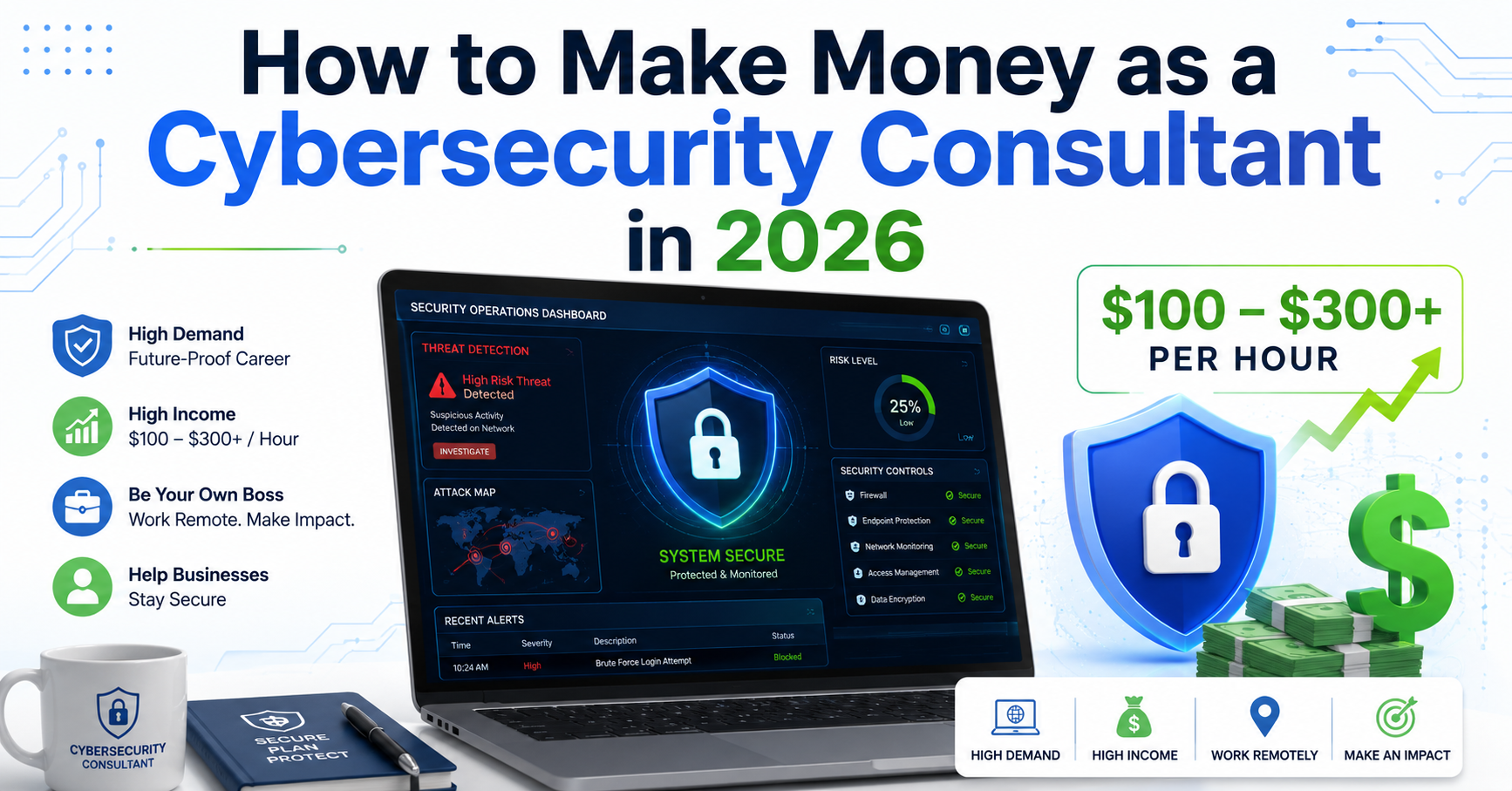
Let me tell you about one of the highest-paying consulting fields that is desperately short on qualified people.
Cybersecurity consulting.
Most people think cybersecurity is something only large corporations with massive IT budgets need to worry about. The reality in 2026 is completely different. Every business, from tiny startups to mid-size companies, is under constant threat. They are getting hacked regularly. They are losing money to ransomware. They are dealing with compliance requirements. And they are desperate for help.
Here is what matters for your income. Companies will pay significant money to solve security problems. A business that gets hacked and loses one hundred thousand dollars in ransom or stolen data will gladly pay five thousand dollars to prevent it in the future. A company facing compliance audits will pay ten thousand dollars for a consultant to help them get compliant. These are not expensive propositions from the company’s perspective.
And here is the beautiful part. You do not need years of experience to start. You do not need advanced technical skills. You do not need to work for a corporation first. You can start offering cybersecurity consulting services as a solo consultant and charge serious rates from day one.
Some cybersecurity consultants make one hundred dollars per hour. Some make three hundred dollars per hour. Some charge five thousand to fifty thousand dollars per project. Some build recurring contracts with clients paying them thousands per month.
This guide is going to show you exactly how to become one of those people.

Why Cybersecurity Consulting Is Booming in 2026
Before we talk about how to make money as a cybersecurity consultant, let me explain why this field is experiencing explosive growth.
The threat landscape is exploding. Ransomware attacks are increasing. Data breaches are becoming more sophisticated. Regulations are tightening. Every week there is a new vulnerability discovered in widely used software. Every month there is a new compliance requirement.
Companies are terrified. They know they need to improve their security. They know they need to be compliant. But they do not know how. They do not have the expertise internally. They cannot afford to hire a full-time security expert. So they hire consultants.
The consultant market in cybersecurity is growing faster than the supply of qualified consultants can keep up with. This creates an enormous opportunity gap. Demand is exceeding supply significantly.
Additionally, cybersecurity has become a financial priority. Boards of directors are demanding security improvements. CFOs are allocating budgets to security. Insurance companies are requiring certain security measures before they will insure a company. Security is no longer a back-office IT concern. It is a business imperative.
This means companies are willing to pay. And they are willing to pay now. There is urgency. A business facing a compliance deadline in two months will pay premium rates for a consultant to help them meet that deadline.
Different Types of Cybersecurity Consulting and What They Pay
Not all cybersecurity consulting is the same. Different specializations pay different rates.
General security consulting is the broadest category. You help businesses understand their security posture, identify risks, and develop security strategies. This pays seventy-five to one hundred fifty dollars per hour for entry-level consultants and two hundred to four hundred dollars per hour for experienced consultants.
Compliance consulting is helping businesses comply with specific regulations — HIPAA, GDPR, PCI-DSS, SOC 2, and others. Companies are desperate for compliance help because the penalties for non-compliance are enormous. Compliance consultants charge one hundred to two hundred dollars per hour, and projects often run five thousand to fifty thousand dollars.
Penetration testing is actively testing a company’s security by attempting to hack into systems. It requires technical skills but is extremely valuable. Penetration testers charge one hundred fifty to three hundred dollars per hour, often with minimum engagements of three thousand to ten thousand dollars.
Incident response is helping companies deal with active security incidents — a breach is happening right now, and you help contain it and investigate. This is urgent and companies pay a premium. Incident response consultants charge two hundred to five hundred dollars per hour plus travel expenses.
Security architecture is designing secure systems for organizations — helping them plan how to build their infrastructure securely from the ground up. This is high-value and highly technical. Security architects charge two hundred to four hundred dollars per hour.
Employee security training is teaching company employees about phishing, passwords, and security best practices. This is lower-technical and more scalable. Training consultants charge one thousand to five thousand dollars per training program.
For a beginner, I would recommend starting with general security consulting or compliance consulting. These are accessible without deep technical knowledge, and the demand is enormous.
Step 1: Build Your Credibility
Credibility is everything in consulting. Nobody will hire you if they do not believe you know what you are talking about.
The most credible way to build credibility is certifications. In cybersecurity, specific certifications are recognized industry-wide.
The CompTIA Security+ certification is the entry-level certification. It is vendor-neutral and widely recognized. The exam costs roughly three hundred dollars. The study process takes one to three months. This certification alone opens doors.
The Certified Ethical Hacker certification is more advanced. It costs five hundred to one thousand dollars and takes two to three months of study. This certification positions you as someone who understands hacking and can test systems.
The CISSP certification is the gold standard. It requires five years of security experience and costs eight hundred dollars for the exam. If you have the experience and can get this certification, you can charge premium rates.
For a beginner with no background in cybersecurity, start with CompTIA Security+. Get that certification. It is worth the investment because it immediately establishes credibility.
Beyond certifications, build experience and case studies. If you help a friend’s business improve their security, document it. Get permission to use it as a case study. Build a portfolio of work you have done.
Create content demonstrating your expertise. Write blog posts about security topics. Create YouTube videos explaining common security mistakes. Share security tips on LinkedIn. This demonstrates knowledge and builds authority.

Step 2: Identify Your Target Market
You cannot be a consultant for everyone. You need to pick a specific market and become the expert in that market.
A small business owner has completely different security needs than an enterprise. A healthcare company has different compliance requirements than a retail company. A SaaS company has different architecture than a manufacturing company.
Pick a market. For example — small business owners with ten to fifty employees. Or healthcare practices. Or e-commerce companies on Shopify. Or professional services firms. Pick something specific.
Why is this important? Because specific markets have specific problems. When you are known as the person who solves security problems for healthcare practices, healthcare practices come to you. You understand their specific compliance requirements. You understand their specific workflows. You become valuable.
Your target market should meet three criteria. First, they have a genuine security need. Second, they have budgets to address that need. Third, they are accessible to you — you know people in that market, or you can reach them through marketing.
Step 3: Set Your Pricing
Consultant pricing is completely different from hourly work.
Most security consultants charge hourly rates. Entry-level consultants with a Security+ certification typically charge seventy-five to one hundred dollars per hour. As you gain experience and certifications, you can charge one hundred fifty to three hundred dollars per hour. Highly experienced consultants with multiple certifications charge three hundred to five hundred dollars per hour.
But hourly rates are not ideal for consulting. Better is project-based pricing. A security assessment of a small business might cost three thousand to seven thousand dollars. A compliance project might cost five thousand to twenty thousand dollars. A penetration test might cost five thousand to fifteen thousand dollars.
The advantage of project pricing is that you can leverage your expertise. A assessment might take you twenty hours but you charge five thousand dollars. That is two hundred fifty dollars per hour — far better than your hourly rate.
For your first few projects, charge on the lower end. Three thousand dollars for a security assessment. Five thousand dollars for a compliance project. You are building credibility and case studies. As you gain experience and testimonials, raise your prices.
Step 4: Find Your First Clients
This is often the hardest part. How do you actually get clients?
Direct outreach is the most effective method. Identify small business owners in your target market. Reach out directly. Email or LinkedIn message them. Explain that you help businesses improve their security. Offer a free thirty-minute consultation to understand their current situation and identify one or two quick wins.
Many will say yes. In that thirty-minute call, you ask about their current security practices. You identify obvious gaps. You suggest two quick wins they could implement immediately. You ask if they would like your help implementing a more comprehensive security plan. Some will say yes.
Your existing network is goldmine. Tell everyone you know that you are a cybersecurity consultant. Ask them to refer people who need security help. Offer a referral fee — twenty percent of the project cost, for example. Your network can bring you clients consistently.
Content marketing works. Write blog posts about security topics and issues affecting your target market. Optimize them for search engines. Over time, people searching for those topics find your content. Some become clients.
Social media, particularly LinkedIn, works for professional services. Post security tips regularly. Engage in security discussions. Share your expertise. Build your following. Eventually, people hire you.
Partnerships can work. Partner with business consultants, accountants, or other service providers who serve your target market. They refer you to their clients who need security help. You share a percentage of fees or refer back to them.

Step 5: Deliver Exceptional Value
Your first few projects determine your reputation. Deliver exceptional work.
Show up prepared. Understand the client’s business before you arrive. Ask good questions. Listen more than you talk. Focus on solving their specific problems, not selling them more services.
Be honest about what you can and cannot do. If a project is beyond your expertise, say so. Refer them to someone who can help. This builds trust.
Document everything. Provide detailed reports. Explain findings clearly. Give actionable recommendations. Make it easy for the client to implement your advice.
Follow up. After the project, check in with the client. See if they have questions. Offer ongoing support. Many consultants use this to transition clients to retainer arrangements — ongoing monthly payments for ongoing security support.
What You Can Realistically Earn
Let me give you honest numbers.
In your first three months, expect to spend time establishing credibility and finding your first client. Expect zero income or one to three thousand dollars if you land a project.
Months four to six, if you land one good project per month, expect three thousand to ten thousand dollars monthly.
Months seven to twelve, with referrals and word-of-mouth building, expect five thousand to twenty thousand dollars monthly.
Year two and beyond, established cybersecurity consultants with a good reputation and regular clients earn twenty thousand to one hundred thousand dollars monthly. Some charge retainers to multiple clients and earn very high income.
The path depends on your starting point. If you already work in IT, you can transition to consulting quickly. If you are starting from scratch, it takes longer to build credibility.
But here is the beautiful part. Once you have three to five good clients paying you three thousand to five thousand dollars monthly on retainer, you have one hundred fifty thousand to three hundred thousand dollars annual revenue. From there, you can scale by hiring other consultants to do the work while you manage client relationships.
Common Mistakes That Limit Your Success
Most consultants make these mistakes early on.
Charging too low. You are an expert. You solve expensive problems. Do not undercharge. Clients often associate price with quality. If you charge too little, they assume you are not that good.
Not specializing. Trying to help everyone with every security issue. Pick a market. Become the expert in that market.
Overselling. Promising more than you can deliver. Under-promise and over-deliver. Build a reputation on doing what you say you will do.
Not following up. Completing a project and moving on. Your first clients should become retainers or refer you to others. Nurture relationships.
Trying to do everything yourself. As you grow, hire other consultants to do implementation work while you focus on client acquisition and strategy.
Tools and Resources You Need
CompTIA Security+ study materials — Three hundred to five hundred dollars
Laptop and security tools — One thousand to three thousand dollars
Business insurance — Five hundred to two thousand dollars annually
Website and business establishment — Free to five hundred dollars
Beyond that, you do not need much. Your expertise is your primary tool.
Final Thoughts
Cybersecurity consulting is one of the highest-paying consulting fields in 2026.
The barrier to entry is reasonable. Get a Security+ certification. Build a website. Start reaching out to potential clients. Deliver great work. Build a reputation.
The income potential is legitimate. One hundred to three hundred dollars per hour. Three thousand to fifty thousand dollars per project. Multiple retainer clients generating consistent monthly income.
The market is booming. Demand for security help exceeds supply. Companies are willing to pay for expertise.
Start today. Get your certification. Build your first case study. Find your first client. From there, a lucrative consulting practice is absolutely within reach.
Have questions about getting started as a cybersecurity consultant? Drop them in the comments below — I read and reply to every single one.
— Usman, EarnGuide
Related Guides
How to Start a Bookkeeping Business from Home in 2026
Best Entry-Level Remote Jobs for Beginners in 2026
How to Make Money as a Virtual Assistant with AI in 2026 — Earn $2K to $5K Monthly
Leave a Reply