I want to start with something most dropshipping articles will never tell you.
Most people who try dropshipping fail. Not because the model is broken — but because they go in with completely unrealistic expectations, pick the wrong products, and give up the moment things get hard.
I am not going to do that to you. This guide is going to tell you exactly what dropshipping is, how it actually works in 2026, what it realistically costs and earns, and the step-by-step process to start without losing money.
If you are looking for a “make $10,000 in your first month” promise, this is not the article for you. If you are looking for the honest truth about whether dropshipping can make you real money — read on.
What Dropshipping Actually Is
Dropshipping is a business model where you sell products online without ever holding inventory.
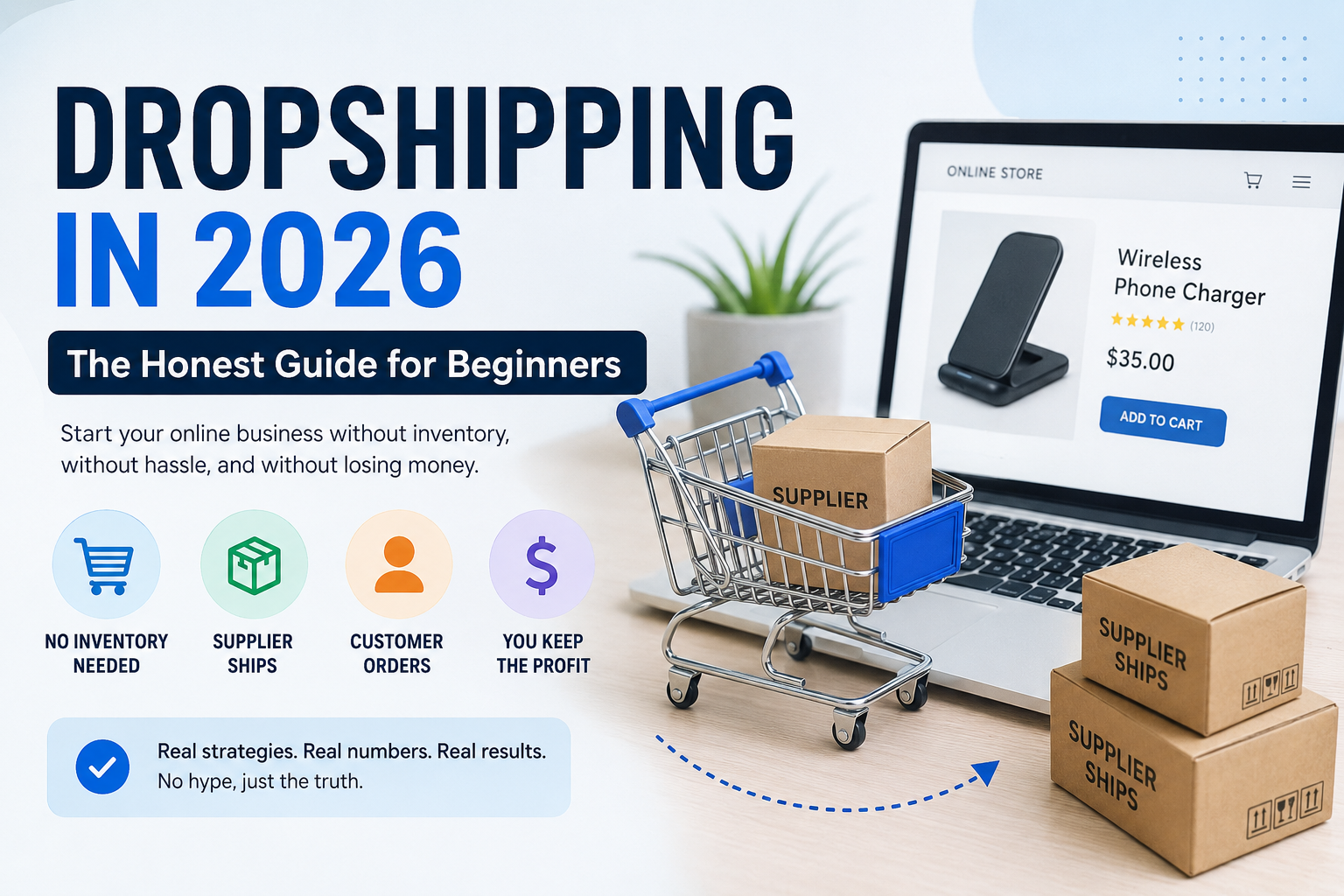
Here is how it works in plain English. You set up an online store. A customer visits your store and buys a product. You forward that order to your supplier — usually a manufacturer or wholesaler. The supplier ships the product directly to your customer. You keep the difference between what the customer paid you and what you paid the supplier.
You never touch the product. You never rent a warehouse. You never deal with packing and shipping.
Example: You list a wireless phone charger in your store for $35. A customer buys it. You order it from your supplier for $12. The supplier ships it directly to the customer. You made $23 on that one sale — minus some small fees.
That is the model. Simple in concept. Not so simple in execution — which is exactly why this guide exists.
Why 2026 Is Still a Good Time to Start
You might have heard that dropshipping is saturated or dead. It is not.
What is dead is lazy dropshipping — copying random products from AliExpress, slapping them in a generic store, and hoping people buy. That stopped working years ago.
What is working in 2026 is niche dropshipping with branded stores, quality suppliers, fast shipping, and real customer service. The bar is higher than it was in 2018 — but so is the opportunity, because most beginners are still doing it the lazy way and failing quickly, which means less competition for people who do it right.
The global dropshipping market was valued at over $300 billion and continues to grow. Shoppers in the USA, UK, Australia, and Canada increasingly buy online, increasingly from smaller niche stores they discover through social media and search. The window is open. You just have to come in the right door.
Step 1: Choose a Niche — This Is the Most Important Decision You Will Make
Do not open a general store that sells everything. That is the number one beginner mistake.
Pick a specific niche — a focused category of products for a specific type of customer. Why? Because a niche store is easier to market, easier to build trust around, and more likely to show up in search results.
Here is what makes a good dropshipping niche in 2026:

People buy it more than once or need multiple related products. A niche like pet supplies, home organization, or fitness accessories keeps customers coming back. One-time purchases are harder to build a business on.
It solves a real problem or fulfills a genuine passion. People buy things that make their life easier or feed a hobby they love. Products in the middle — not useful, not passion-driven — are hard to sell.
It has room for branding. You want to be able to build a store that feels like a real brand, not just a random collection of products.
Some strong niche examples for 2026: eco-friendly kitchen products, home office accessories, pet wellness products, minimalist home decor, hiking and outdoor gear for beginners, posture and ergonomic tools.
Avoid anything with obvious copyright issues like branded goods, anything fragile that creates constant return requests, and any niche so saturated it would take years to break through — like phone cases for major brands.
Step 2: Find a Reliable Supplier
This step determines whether your business succeeds or fails. A bad supplier means late shipments, poor quality products, and unhappy customers who leave bad reviews and request refunds.
Here are the best supplier options in 2026:
AutoDS is one of the best platforms for beginners. It connects you with vetted suppliers, automates order processing, and has a product research tool built in. It supports Shopify, eBay, and other platforms. Pricing starts around $9.90 per month.
Zendrop focuses on faster shipping — most products arrive in 5 to 10 business days to US customers, which is a significant improvement over the 3 to 4 week waits that killed many early dropshipping stores. They also offer branded packaging, which makes your store look more professional.
Spocket specializes in suppliers based in the USA and Europe. This means faster shipping times and better product quality. Perfect if your target customers are in the USA, UK, Canada, or Australia. Plans start free with limited access, paid plans around $39.99 per month.
CJdropshipping is free to use and has a huge catalog. Quality and shipping times vary by product and supplier, so research carefully before listing.
The rule with suppliers: always order a sample before listing a product in your store. You need to see the product quality, feel how it is packaged, and experience the shipping time yourself before you ask customers to trust you with their money.
Step 3: Build Your Store
You do not need to be a developer. You do not need to know how to code. Building a dropshipping store in 2026 is accessible to complete beginners.
Shopify is the standard platform for dropshipping and for good reason. It integrates directly with every major supplier platform, has thousands of apps and themes, and is built specifically for e-commerce. Plans start at $39 per month after a free trial.
WooCommerce is a free plugin for WordPress. If you already have a WordPress site, this is worth considering — but the setup is slightly more technical than Shopify.
When building your store:
Keep it clean and focused. A cluttered store with dozens of product categories looks untrustworthy. Start with 10 to 20 carefully chosen products in your niche.
Write real product descriptions. Do not copy and paste the supplier’s description. Write it yourself — explain the product clearly, mention who it is for, and answer the questions a real buyer would have before purchasing.
Use real photos. Many suppliers provide photos. If the photos look generic or low quality, consider ordering the product and photographing it yourself or using lifestyle images from free sites like Pexels.
Set up a real About page, Shipping Policy, and Refund Policy. These are not optional. Customers in the USA and UK expect to see these before they trust a new store. Without them, you will lose sales before people even add items to their cart.
Step 4: Price Your Products Correctly
Pricing is where many beginners either leave money on the table or price themselves out of the market.
Here is a simple framework.

Find your product cost from the supplier. Add shipping. Multiply by 2.5 to 3 for your selling price. Then check if that price is competitive with similar products on Amazon and other stores.
Example: Supplier cost $8, shipping $4, total cost $12. Multiply by 2.5 = $30 selling price. If similar products on Amazon sell for $25 to $45, you are in a good range.
Do not try to compete purely on price. Competing on price against huge suppliers means racing to the bottom and making nothing. Compete on branding, product descriptions, customer service, and the overall store experience.
Step 5: Get Your First Customers
This is the hardest part — and the part nobody wants to talk about honestly.
Having a store does not mean having customers. You have to drive traffic, and in the beginning, that means putting in real work.
Pinterest is one of the best free traffic sources for e-commerce. Create a Pinterest business account, design pins showing your products, and link directly to product pages. Pinterest has a particularly strong audience in the USA for home, lifestyle, and wellness products. This is completely free and compounds over time.
TikTok organic content works extremely well for dropshipping in 2026. Short videos showing the product in use — unboxings, demonstrations, before and after — can go viral with zero ad spend. You do not need a massive following. One video showing a genuinely useful product can drive thousands of visits to your store.
SEO and blogging is the long game. Writing helpful articles about topics related to your niche — and including links to your products — brings consistent, free traffic from Google. It takes three to six months to see results, but once it kicks in, it requires no ongoing spend.
Paid ads are the fast lane — but they cost money and require testing. Facebook and TikTok ads can drive traffic immediately, but expect to spend $200 to $500 testing before you find a winning ad. Only move to paid ads once you have validated your product and store organically first.
Step 6: Handle Customer Service Like a Real Business
This is the difference between a store that survives and one that dies in its first three months.
Reply to every customer email within 24 hours. Set up a clear and fair refund policy — and actually honor it. If a product arrives damaged or late, make it right without making the customer fight for it.
Happy customers leave reviews. Reviews build trust. Trust drives sales. This cycle is how dropshipping stores actually grow.
Use a free tool like Tidio to add a live chat feature to your store. Even if you are not always available, having a visible chat option increases conversion rates significantly because it signals that there is a real person behind the store.
What You Can Realistically Earn
I promised you honest numbers, so here they are.
In your first month, most beginners make zero to a few hundred dollars. Many make their first sale within the first two weeks if they have done their product research and are actively driving traffic. Some make nothing and have to adjust their product or marketing approach.
By month three, beginners who stayed consistent and made adjustments based on data are often doing $500 to $2,000 in monthly revenue. Profit margins in dropshipping average 15 to 30 percent, so on $1,000 in revenue, expect $150 to $300 in actual profit after costs.
By month six to twelve, dropshippers with a validated niche, a clean store, reliable suppliers, and consistent marketing are hitting $3,000 to $10,000 in monthly revenue. At those numbers, the business starts to feel real.
The honest caveat: these numbers assume you are testing, learning, and adjusting constantly. Dropshipping is not passive income in the beginning. It requires active management — customer service, product testing, marketing, supplier communication. Over time, as systems are in place, it becomes more hands-off.
What It Costs to Start
You can start dropshipping with as little as $100 to $200 if you are disciplined.
Here is a realistic starting budget:
Shopify basic plan: $39 per month. A simple theme: free options available. Supplier platform like AutoDS or Spocket: $10 to $40 per month. A sample order for the product you plan to sell: $15 to $30. Canva Pro for product graphics and marketing: $15 per month. Total startup cost: approximately $80 to $130 per month.
This assumes you are driving traffic organically through Pinterest and TikTok rather than paid ads. If you add paid advertising, budget another $200 to $300 for initial testing.

The Most Common Reasons Beginners Fail
I want you to succeed, so I am going to be direct about why most people do not.
They pick a bad product. Random products with no demand or too much competition do not sell. Product research is not optional — it is the foundation of everything.
They expect results too fast. Most successful dropshipping stores took three to six months of consistent work before they became profitable. Giving up at week four is giving up right before things start working.
They have slow shipping. Customers in the USA expect delivery within 7 to 10 business days at most. If your supplier is shipping from overseas with 3 to 4 week delivery times, your reviews will suffer and your refund rate will be high.
They ignore customer service. Treating customer service as a nuisance rather than a business investment is the fastest way to kill a store’s reputation.
They skip the sample order. Listing products you have never seen or touched is how you end up with angry customers posting photos of cheap, disappointing products.
Tools That Will Actually Help You
Ecom Hunt and AutoDS Product Research — for finding trending products before they saturate.
Google Trends — completely free tool to validate whether product interest is growing or declining.
Canva — for creating product graphics, store banners, and Pinterest pins.
Shopify’s built-in analytics — for understanding where your traffic comes from and which products people actually buy.
Tidio — free live chat for your store.
Final Thoughts
Dropshipping in 2026 is not the gold rush it once was. The easy wins are gone. But the sustainable opportunity — building a focused niche store with real products, reliable suppliers, and genuine customer service — is very much alive.
The people making real money with dropshipping right now are not doing anything magical. They are doing the basics exceptionally well. Good product research. Clean stores. Fast suppliers. Real customer service. Consistent marketing.
That is a higher bar than 2018. But it is also a bar that any determined beginner can clear.
Start small. Pick one niche. Find one reliable supplier. Build one clean store. Test one product at a time.
The first sale feels incredible. And it is usually the one that makes everything click.
Have questions about starting your dropshipping store? Drop them in the comments — I read and reply to every single one.
— Usman, EarnGuide
Related Guides
How to Start a Print-on-Demand Business with Free Tools in 2026
How to Sell Digital Products Online in 2026 and Make Money While You Sleep — Beginner’s Guide
Leave a Reply